
The old Saxon poem “Do the Next Thing”, made popular by Elisabeth Elliot, is a wonderful encouragement to trust and obey God moment by moment.
One of my favorite people (that I’ve never met) and examples of Biblical womanhood is Elisabeth Elliot. I first learned about her through the book Passion & Purity someone gave me as a gift as a teenager.
I was reacquainted with her as an adult and a mother through her quotes, writings, and recordings of her talks. I so enjoy listening to her. As sober as much of her teaching is, she was very down to earth and honest about herself. She didn’t pretend to be someone special or admirable. She simply learned obedience through her suffering similarly to Jesus, and humbly shared what the Lord taught her with other women.
Providence
One of the subjects that Elisabeth talked about a lot is the idea of Providence.
The Merriam-Webster dictionary defines providence as “divine guidance or care; God conceived as the power sustaining and guiding human destiny”.
The 1828 Webster’s dictionary says it this way (emphasis mine):
In theology, the care and superintendence which God exercises over his creatures. He that acknowledges a creation and denies a providence involves himself in a palpable contradiction; for the same power which caused a thing to exist is necessary to continue its existence. Some persons admit a general providence but deny a particular providence not considering that a general providence consists of particulars. A belief in divine providence is a source of great consolation to good men. By divine providence is often understood God himself.
When you read the writings of “good men” (and women) through history who reference Providence, you frequently find a tone of warmth and affection as well. It is a comforting truth, that the hand of the One who skillfully created you is intimately acquainted with and directing your ways.
O Lord, you have searched me and known me!
Psalm 139:1-6 ESV
You know when I sit down and when I rise up;
you discern my thoughts from afar.
You search out my path and my lying down
and are acquainted with all my ways.
Even before a word is on my tongue,
behold, O Lord, you know it altogether.
You hem me in, behind and before,
and lay your hand upon me.
Such knowledge is too wonderful for me;
it is high; I cannot attain it.
The heart of man plans his way,
Proverbs 16:9 ESV
but the Lord establishes his steps.
…for ‘In him we live and move and have our being’; as even some of your own poets have said, ‘For we are indeed his offspring.’
Acts 17:28 ESV
Nothing is left to chance or fate. Even the rolling of the dice is in His hand.
Grace
Wrapped up in this idea of Providence is tremendous grace. Remembering God’s complete and sovereign control reminds us of how very finite we are and how that’s exactly what he means us to be.
As a father shows compassion to his children,
Psalm 103:13-14 ESV
so the Lord shows compassion to those who fear him.
For he knows our frame;
he remembers that we are dust.
We don’t impress him by pretending to know more or be more or have the ability to do more than we can actually do. We don’t impress him at all really! That’s not our job. It’s our job to be impressed by him. To worship him. To serve him in our very limited capacities and be assured that that is all he asks of us.
We are also reminded of his grace in his tender Providential mercies toward us.
The Lord gives hard providences for sure. Elisabeth Elliot experienced many of those which you might expect would harden her against him. But as with any true child of the King, the fire is intended only to refine and purify us, not to harm us.
His tender, daily thoughtfulness of us can help us through the fire. His little gifts that show that he sees us, he knows us, and he cares deeply for us are a balm to the soul, if we can only pause to notice them. He is always showing his children they are his and they are loved, in big ways and in the small. He lets us see his tender heart in them, and offers a chance for us to respond in gratefulness and worship.
Obedience
Obedience is a natural response to God’s gracious providence. Obedience sees that God has it all, that I don’t have to, but also sees God’s provision and kindness toward me and responds in acts of obedience.
I talked in this post about how the gospel encompasses what we think of as grace and what we think of as law. The law has been redeemed through the gospel in the sense that the weight of it is removed by Jesus sacrifice on our behalf and now we are free to obey. We don’t have to be crushed by the law but can instead be sanctified little by little in learning how to obey it.
Sanctification is fully a work of God in me and I am called to choose to obey at the same time. It’s a mystery we can’t fully understand or explain, but God in his providence can handle it.
So moment by moment, because Jesus lives in me, I can choose to respond in obedience to my King who watches over me. As he places each individual step before me, I can humbly walk in it and let go of all the others.
The Poem
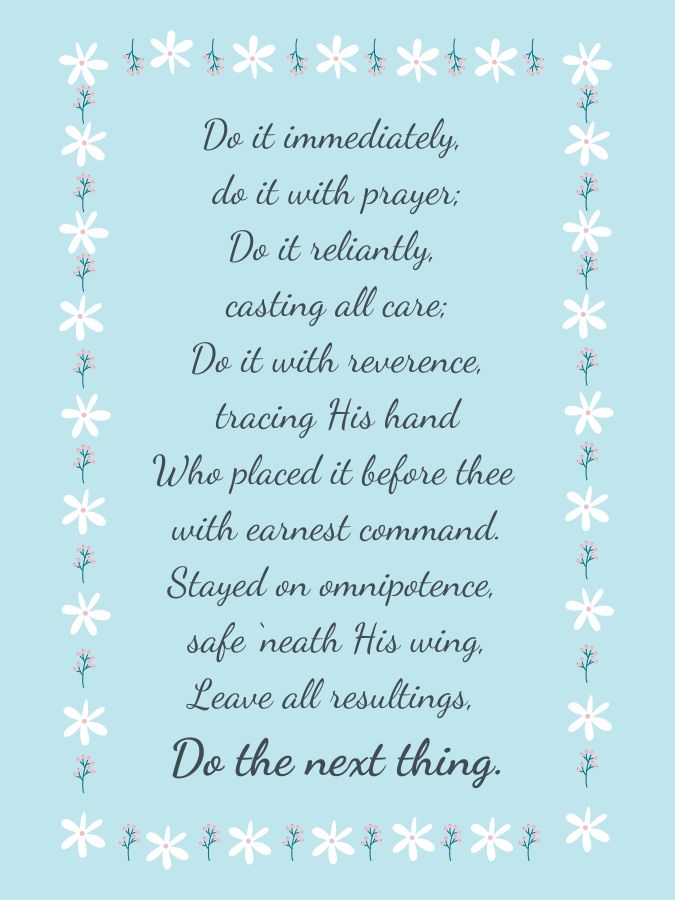
The poem that you saw in the image at the beginning of this post was made popular by Elisabeth Elliot. She discovered it after she was widowed (the first time). She was a young mother, grieving the death of her husband, living in a foreign tribe and trying to oversee the missionary station that her husband had run before his death. She was overwhelmed and undertrained for the work she needed to do.
The Lord gave her this poem to cling to and gently reminded her to just take it one step at a time. He would guide her, but it would only be one step, then another, then another. She didn’t need to see the whole map, she just needed to walk in the good works he had prepared for her one step at a time.
It’s the same for you and me. I imagine you are probably in a nicely air conditioned home in the United States. You probably have dishwashers and vacuum cleaners at your disposal. I’m guessing most, if not everyone, around you speaks English. We both likely have many advantages over the situation that Elisabeth found herself in, living in a hut in the jungle trying to simultaneously learn and translate a foreign language in order to function and serve others each day.
But I’d also guess that your life is still hard. We all experience our own kinds of hard. For God’s people, there isn’t really a choice between hard and easy, there are only different kinds of hard. Sometimes the trials pummel us from the outside. Sometimes most of it lives in our head, in our worries and temptations. In our feelings of inadequacy and unpreparedness for what God has called us to. Sometimes the struggle of trying to work through our attitude problems and the attitude problems of all the little humans God has given us at the same time feels like enough to drive us crazy!
Don’t give up. Don’t give in. Don’t let the enemy convince you that you need to do it all or do it perfectly.
Find comfort in God’s loving Providence and in the words of this old poem and…
Do The Next Thing
From an old English parsonage down by the sea
There came in the twilight a message for me;
Its quaint Saxon legend, deeply engraven,
Hath, as it seems to me, teaching from Heaven.
And on through the hours the quiet words ring,
Like a low inspiration: DO THE NEXT THING.
Many a questioning, many a fear,
Many a doubt, hath its quieting here.
Moment by moment let down from Heaven,
Time, opportunity, guidance are given.
Fear not tomorrows, child of the King,
Trust them with Jesus. DO THE NEXT THING.
Do it immediately; do it with prayer;
Do it reliantly, casting all care;
Do it with reverence, tracing His hand
Who placed it before thee with earnest command,
Stayed on Omnipotence, safe ‘neath His wing,
Leave all resultings. DO THE NEXT THING.
Looking to Jesus, ever serener,
(Working or suffering) be thy demeanor.
In His dear presence, the rest of His calm,
The light of His countenance be thy psalm.
Strong in His faithfulness, praise and sing!
Then, as He beckons thee, DO THE NEXT THING.
You will find this poem in it’s entirety taped above my kitchen sink where I have worked on memorizing it little by little…I highly recommend you do the same! It truly is a great consolation.
Additional Resources
Go here to listen to recordings of Elisabeth Elliot’s wonderful teachings that have been carefully preserved.
You can find her books here.
Check out more of my posts:
It All Starts {and Ends} With the Gospel
Leave a Reply